
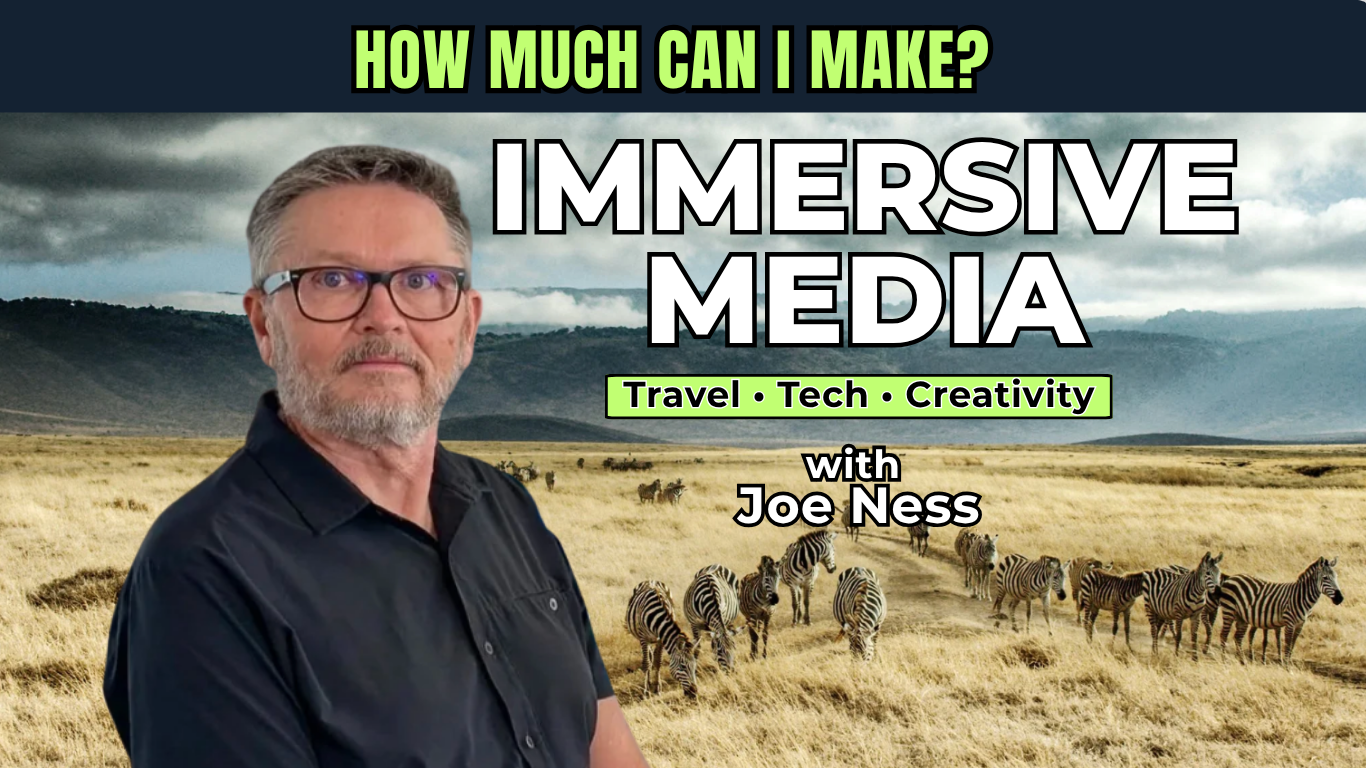
Immersive Media Producer Career: Real Pay, Global Travel & Creating Content That Heals
$60K – $300K+
Joe Ness spent nearly 20 years as the in-house immersive content director for a major casino conglomerate — earning over $300,000 a year and traveling to nearly 100 countries to shoot the footage that filled their LED walls. Then he walked away to build something he cared about more. His company,Windows of the World (WOW), now delivers cinematic nature content to healthcare facilities, mental health centers, and assisted living communities. In this episode, he breaks down what the job pays, what it actually costs to build it, and why he bet hundreds of thousands of his own dollars on a fresh start at 65.
What you’ll learn in this episode:
- How a South Dakota farm boy went from AV contractor to immersive content director earning $300K+
- What it’s like to shoot wildlife in Rwanda, penguins in Antarctica, and the Delta Blues in Clarksdale, Mississippi
- How the business model actually works — licensing, video wall design, footage sales, and the app opportunity
- What RED cameras, Hasselblad, and 8K at 60fps have to do with healing anxious patients
- Why he left a guaranteed $300K salary and funded a startup entirely out of pocket
- How the WOW Academy is paying student filmmakers in Kenya, India, and Vietnam — and putting their footage on World Cup screens
- The $4 billion comparison that might be the biggest market opportunity in immersive media right now
How much can you earn?
Immersive media is a broad field that combines filmmaking, video production, digital signage, visual storytelling, content licensing, and experiential technology. Earnings vary dramatically depending on whether you’re working as a creator, freelancer, technician, producer, or business owner.
Entry-level video producer / content creator: $50K–$80K
Experienced cinematographer or media producer: $80K–$150K+
Creative director / immersive media specialist: $120K–$250K+
Business owner with licensing and installation revenue: $200K–$300K+ and potentially much higher
Large immersive media projects: Can range from $10,000 to hundreds of thousands of dollars depending on scope, equipment, travel, and installation requirements.
What does an immersive media producer actually do?
Immersive media producers create visual experiences designed for large screens, LED walls, public spaces, healthcare facilities, museums, casinos, airports, entertainment venues, and experiential environments. The work combines creative storytelling with technology and business strategy.
A typical project may involve scouting locations, filming with drones and cinema cameras, color grading footage, designing content for ultra-high-resolution displays, managing teams across multiple countries, licensing media assets, and working with architects, engineers, healthcare providers, or venue operators.
Unlike traditional filmmaking, immersive media often focuses on creating an experience rather than telling a linear story. The goal may be to inspire, calm, entertain, educate, or transform a physical space.
Why immersive media is growing
Several trends are driving growth in immersive media careers:
- Falling costs of large LED displays
- Growth of experiential marketing
- Expansion of digital signage networks
- Healthcare interest in wellness-focused environments
- Demand for high-quality visual content
- Advances in drone and camera technology
- New applications in education, museums, and public spaces
As organizations look for new ways to engage visitors, customers, patients, and residents, immersive visual experiences are becoming more common across industries.
You may also like:
Explore more Creative Careers →
FAQ
What is immersive media?
Immersive media refers to visual, audio, and interactive experiences designed to engage viewers more deeply than traditional media. Examples include LED video walls, projection mapping, virtual reality, large-format displays, experiential installations, and digital environments.
How much do immersive media professionals make?
Entry-level professionals may earn $50,000–$80,000 annually, while experienced producers, cinematographers, creative directors, and business owners can earn $150,000–$300,000+ depending on their expertise and business model.
Do you need a film degree to work in immersive media?
No. Many professionals come from backgrounds in filmmaking, photography, communications, design, technology, engineering, or visual arts. A strong portfolio and technical skills are often more important than a specific degree.
What equipment is used in immersive media production?
Common tools include cinema cameras, drones, LED display systems, editing software, color grading tools, media servers, audio systems, and increasingly AI-assisted production workflows.
Is immersive media a growing career field?
Yes. Growth in digital signage, experiential marketing, healthcare technology, tourism, entertainment, and public installations has increased demand for immersive media content and production services.
How do immersive media companies make money?
Revenue can come from content licensing, installation design, consulting, display systems, custom productions, recurring content subscriptions, media libraries, and experiential events.
Can you start an immersive media business as a freelancer?
Yes. Many professionals begin as videographers, photographers, drone operators, editors, or content creators before expanding into licensing, installations, consulting, and larger-scale immersive experiences.
This show first aired in June 2026.