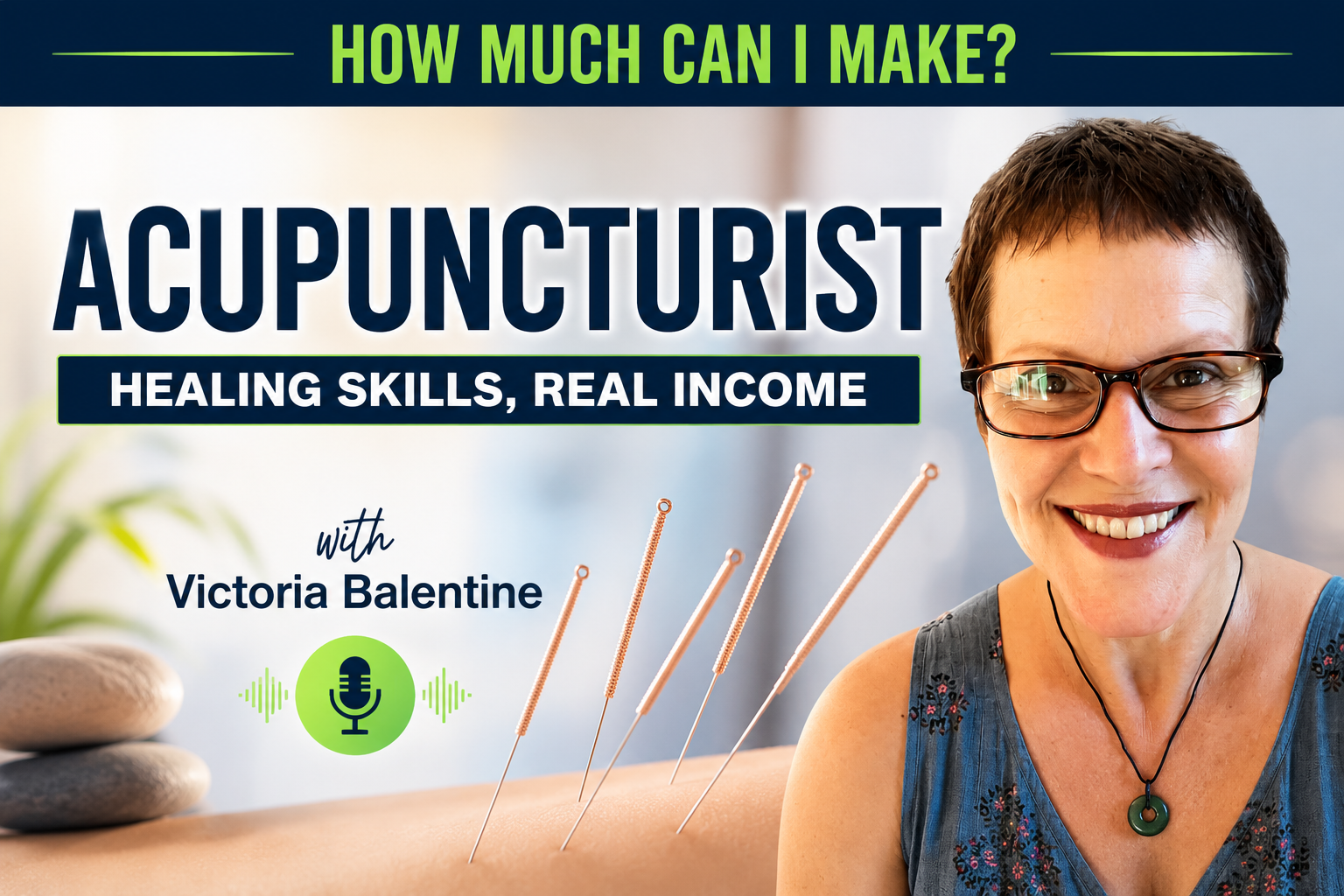
Acupuncturist Reveals the Business, Salary & Reality of Running a Clinic
$70K–$200K+
Potential earnings depend heavily on location, patient volume, specialty, rent, referrals, and whether you own the practice.
7/15/25
Victoria Ballantyne spent 20 years running a thriving acupuncture clinic in Manhattan, specializing in women’s reproductive health and fertility. She worked alongside reproductive endocrinologists, taught other practitioners across the country, and built a practice from scratch — starting with a base of yoga students and growing it into something worth buying.
What you’ll learn in this episode:
- What it actually takes to become a licensed acupuncturist
- How to build a specialty practice (and why reproductive health became her niche)
- How much you can earn — and what a busy clinic day looks like financially
- How to run a small healthcare business, compete in a saturated city, and eventually sell it
How much can you earn?
Victoria charged $120 per session and at her busiest saw two patients per hour. That’s $240 an hour in revenue — before rent, staff, and overhead.
Manhattan clinic space runs $5,000–$10,000 a month depending on location and size. Factor in employees, continuing education, marketing (she spent heavily on Google AdWords in the early days), and the numbers shift considerably. But a well-run solo or small-group practice can be genuinely profitable — especially if you specialize.
The earning tiers roughly break down like this:
Employee acupuncturist — If you work for someone else at an hourly wage, income tends to be modest. Victoria is direct about this: employees in this field don’t necessarily make great money. It can be a starting point, but it’s not where the financial upside lives.
Solo practice owner — This is where earning potential opens up. With a full schedule, a niche, and a steady referral network, you’re looking at a real small business with real margins. The work is clinical and entrepreneurial in equal measure.
Specialist with a teaching practice — Victoria eventually layered in continuing education courses that she taught to other acupuncturists nationwide. That additional revenue stream came from having built something distinct — a curriculum no one else had created around acupuncture, herbs, and women’s reproductive health.
Typical potential ranges:
- Employee / early career: $45K–$75K
- Private practice owner: $80K–$150K+
- Specialized, high-volume clinic owner: $150K–$200K+
What does an acupuncturist actually do?
Acupuncture is one branch of Chinese medicine; the other is herbal medicine. Victoria trained in both, completing a nearly four-year program at Pacific College of Oriental Medicine in Manhattan. She started treating the usual presenting issues — migraines, back pain, neck pain — and added a certification in palliative care through Memorial Sloan Kettering. Then a patient with recurrent miscarriage asked her to help, and everything shifted.
Reproductive health became her specialty because it was complex, underserved, and sat at the intersection of Eastern and Western medicine in ways that required her to deeply understand both. She read the same journals as the reproductive endocrinologists she worked alongside. She knew the drugs, the protocols, the statistics. That fluency is what made referring doctors take her seriously — and what eventually made patients seek her out specifically.
On a typical busy day, she saw patients back to back: two per hour, four days a week, with a trusted associate covering the rest. The fourth-day schedule wasn’t a lifestyle choice at first — it was a business decision. Her patients needed to trust someone else in the practice, and that required deliberate, careful introduction.
YOU MAY ALSO LIKE THESE EPISODES:
Chronic Pain Relief – Hypnotherapist →
FAQ
- How much can an acupuncturist make?
Acupuncturists typically earn between $50,000 and $120,000+, with private practice owners earning $150,000+ depending on location and client volume. - Do acupuncturists get paid per session?
Yes—many charge per session, often ranging from $75 to $200+, with additional income from packages or specialized treatments. - What education is required to become an acupuncturist?
Most need a master’s degree in acupuncture or Traditional Chinese Medicine and must pass licensing exams depending on the state. - Where do acupuncturists work?
They may work in private practices, wellness centers, integrative medical clinics, or alongside other healthcare providers. - Is acupuncture a good career?
It can be a strong career for those interested in holistic health, with steady demand and the potential to build a flexible, independent practice.